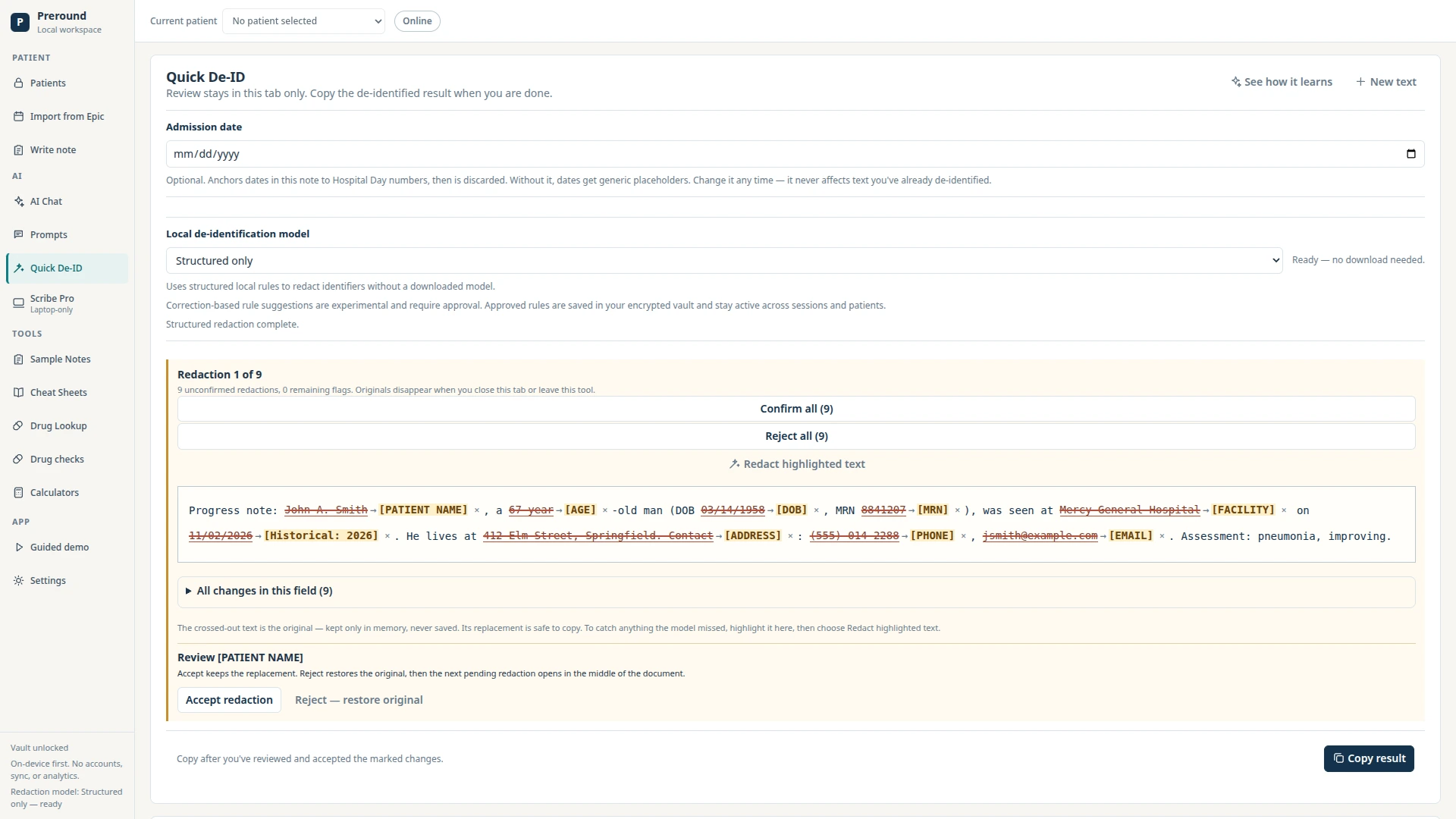
A de-identifier that runs entirely in the browser, tested on 1,381 real clinical narratives, that learns from the corrections clinicians already make.
Scrub this note · the real tool, in this browser tab
Fictional text only. Never paste a real patient's note.
Pick a sample, or paste your own fictional text. This is the real Quick De-ID component from the prerounding app, with its real model, not a word list: type a name it has never seen and that is the normal case. Whatever it misses, the review queue is where you catch it.
Model: Stanford clinical deidentifier, 110 MB, downloads once, then runs offline on this device. Pack: onnx-community/stanford-deidentifier-base-ONNX, 109,651,017 bytes in 14 pieces, served from this site and loaded only when you press Scrub. First load takes a moment; it runs best on a laptop.
Sent to a server: 0 bytes Note text is never put in a request. After the pack is on this device, a run makes no network calls at all.
Structured only runs the component’s own rule layer with no model download. It is the fallback the model error message names. It catches less than the model run, and review stays mandatory either way.
Input changed. The output below is out of date: it shows the last run, not the text now in the box. Press Scrub to run the current text.
The clinic sample is loaded. Press Scrub to run the real model on it.
This evaluation is neither Safe Harbor nor Expert Determination conformance, and the output must be treated as still containing PHI until one is separately done.
The honesty beat. The trap note above is loaded and scrubbed. In the manuscript, the strongest setup still left at least one missed identifier in 30.7% of notes. Read the scrubbed note: if you can see something the tags missed, highlight it in the note and mark it. That correction, not the count, is why review stays mandatory.
See how it learns runs the app's real rule proposer on synthetic notes: make the same correction a few times and it proposes a plain-English rule for your approval. In the study behind this, 40 corrections lifted a browser model from F2 0.5348 to 0.6362. The full app, with its vault and every model pack, is at the prerounding checklist.
A de-identifier that runs entirely in the browser: a neural model, a deterministic rule layer, mandatory clinician review, and nothing sent anywhere. Identifiers are scored across nine categories: AGE, DATE, DOCTOR, HOSPITAL, ID, LOCATION, PATIENT, PHONE, and WEB.
Results
Tested on 1,381 SHIELD notes holding 10,229 gold identifier spans, scored with F2. The Stanford website model reached F2 0.8287; no adaptation method improved it. The rule layer lifted all eight browser models (mean +0.1009 F2; GLiNER 0.5348 to 0.6858), and learning from clinician corrections raised GLiNER to 0.6362 after 40 corrections. The limit: at least one missed identifier remained in 30.7% of notes, so review stays mandatory, and this evaluation is neither a HIPAA Safe Harbor nor an Expert Determination check. Manuscript: “Browser-Local De-identification of Clinical Text,” reserved draft on Zenodo, DOI 10.5281/zenodo.23372242 (does not yet resolve).