Try it: fill in the blanks · a worked example
A home DNA kit reads only some of the markers that go into a breast cancer risk score. The rest are blank. This worked example shows how FastImpute fills them in.
Each tile is one marker (a SNP): its genotype is the pair of letters a person carries at that position. The 24 tiles are a real segment of chromosome 1 from the sample 23andMe file in the FastImpute repo (test_files/11576.23andme.9465.txt), labeled by strip position (pos 1 to 24) and rs number, such as rs3131972.
Worked example with prewritten answers. No model runs on this page. Sixteen tiles show the genotypes the sample file really carries. Eight tiles are blanked out, and the Impute button fills each blank with a prewritten guess. Reveal then shows the true genotype from the file beside each guess, with a tick or a cross, so you can count the score yourself. The confidence under each guess is an illustrative value written for this example. It is not output from a model.
Teaching scale: the real score, PRS313, uses 313 markers. A home kit measures 77 of them and leaves 236 blank (75 percent). This strip blanks 8 of 24 (33 percent) so the whole idea fits on one screen.
Reveal unlocks after imputing.
The paper’s result, for comparison
PRS-score R2 against sequencing, overall breast cancer, from the paper’s test set of 501 people. R2 says how closely the score built from filled-in markers tracks the score built from true sequencing. 1.0 is perfect.
FastImpute, R2 = 0.86
Frequency-based baseline (the paper’s no-imputation and MAF-imputation scores), R2 = 0.38
Beagle, the standard tool, R2 = 0.95
These are the paper’s published evaluation numbers, not a result computed from your strip. Note: the code repository’s README still carries the earlier preprint baseline numbers (0.33 for no imputation, 0.28 for MAF imputation). The bars above use the published paper’s numbers.
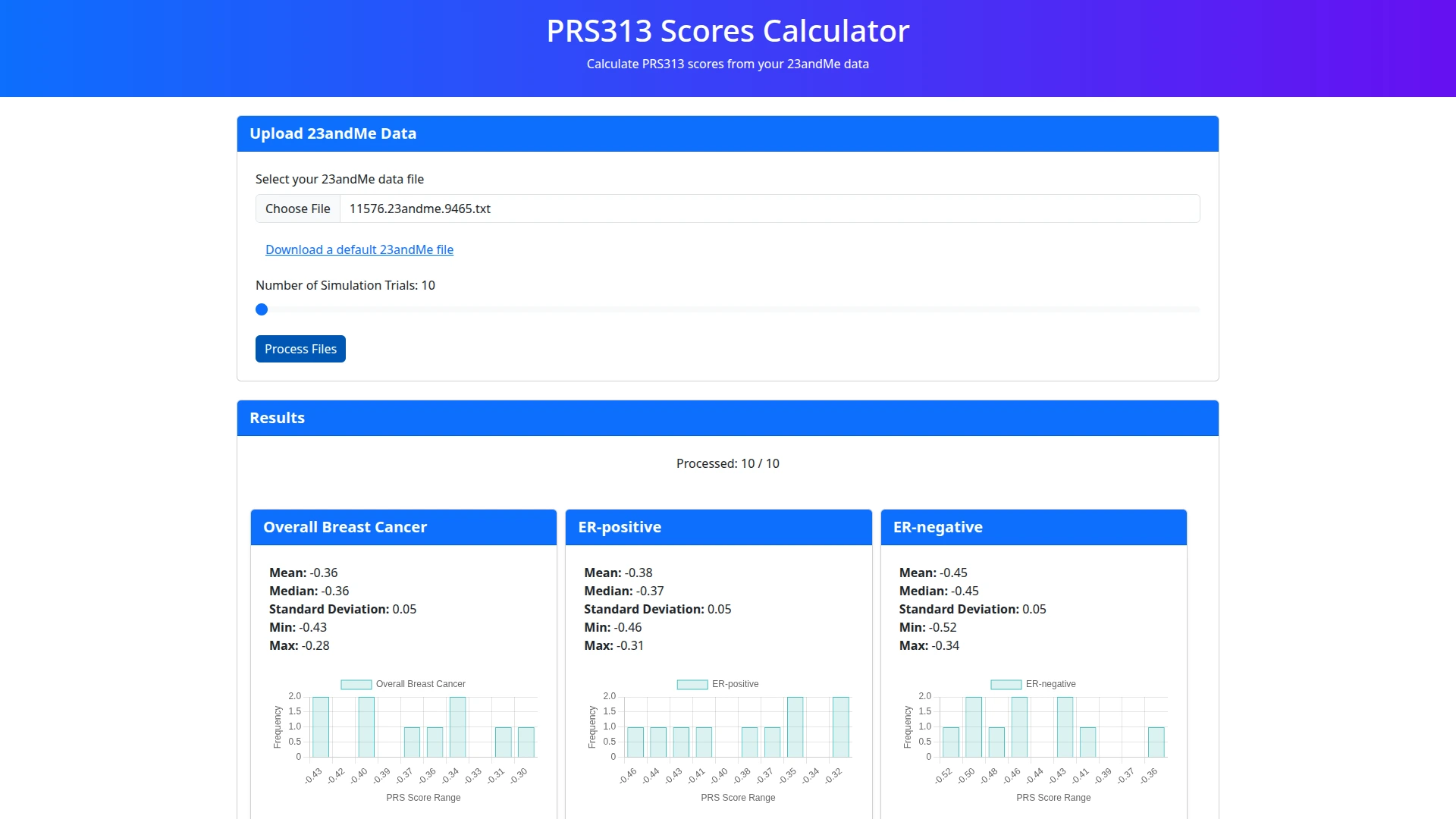
The strip above is a worked example with prewritten answers. The real tool runs the full model in your browser: Open the live FastImpute app. You will need a 23andMe file, or use the default file the app offers on its first screen. Nothing you load there leaves your device.
A breast cancer risk score needs 313 DNA markers. A home DNA kit measures 77 of them. FastImpute predicts the rest, in your browser, without your genome ever leaving your device.
Genotype imputation fills in the markers a DNA test did not measure. Standard tools run on servers, so the genome is uploaded and queued. FastImpute trains small, simple models that run on the device in front of you.
Results
For PRS313_BC (PGS Catalog PGS000004), only 77 of 313 markers are on the 23andMe V5 chip, so 236 are predicted (count from 119 public 23andMe V5 files on OpenSNP). On held-out 1000 Genomes sequencing (2,504 people; 501 tested), the score from imputed genotypes tracks true sequencing at R2 = 0.86, against 0.38 for frequency guessing and 0.95 for Beagle 5.4. The web app runs 1,000 simulations in under 10 seconds locally. The score is not calibrated by ancestry group. Paper: DOI 10.2174/0118750362421210250929110508. Code: github.com/aaronge-2020/FastImpute. Live tool: aaronge-2020.github.io/FastImpute.