Try it: one case
You are the doctor. This is one short, fictional teaching case in the shape of the full simulator: ask, examine, order, treat, then commit. Nothing here is a real patient. Leaving this page discards the case in progress.
ED encounter · Chest pain
Marcus, 58, arrived ten minutes ago complaining of chest pain.
You are scored on: the cues you find, ordering the ECG, your diagnosis, your disposition, and the treatment you start. Diagnosis and disposition credit needs a minimum workup: the ECG, plus at least two questions or the exam. Session limit: 5 minutes. When the limit arrives, you will be told to commit.
Step 1 · Ask and examine
Step 2 · Orders
Step 3 · Treatment
Pick any that you would start now:
Step 4 · Commit
Pick a diagnosis and a disposition to continue. Commit locks both picks; nothing is revealed before you commit.
A short scripted sample, built from the simulator’s own case material. It is not the full simulator: the full simulator runs longer cases with an AI patient, on its own backend. Open the live simulator. The Case Studio is the separate faculty authoring tool; the simulator is the learner product. ECG tracing: a real recording from the PTB-XL database (PhysioNet), record 08075, licensed CC BY 4.0. Leaving this page discards the case in progress.
Clinical reasoning is the one skill medical school never directly tests. Students learn it by lottery, from whichever patients happen to arrive on their shifts. SimED lets a student run a full emergency department encounter, a patient who talks back and deteriorates on a clock, and then grades the reasoning itself.
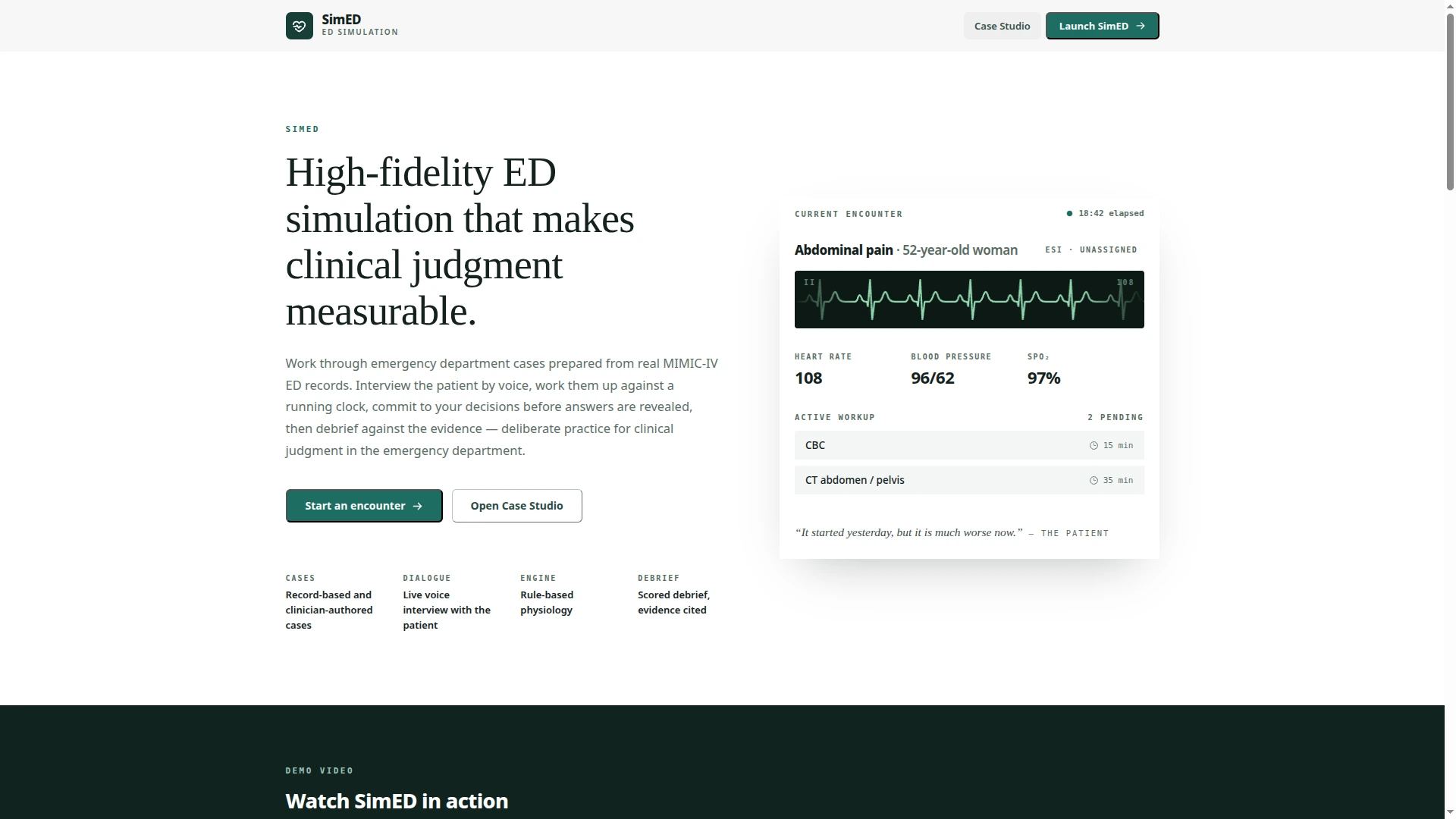
SimED runs a full emergency department encounter in the browser: triage and ESI, a voice history from authored patient facts, 170+ real exam findings, orders at real CMS prices, a ranked differential, a SOAP note, and a deterministic debrief scored against a faculty-authored 100-point rubric. The AI patient can only say what the case author wrote, and no interpretation is shown before the learner commits their own. Faculty author cases in the Case Studio.
Status
A working, live simulator with a case library across chest pain, dyspnea, abdominal pain, altered mental status, syncope, and sepsis. The ICTR ATIP application (PI Dr. Phipps) seeks funding for the 30-case library and the validation study: n=60 across medical students, residents, and attending physicians, scored on diagnostic accuracy, differential completeness, and ordering efficiency. The study has not run yet.